In the context of truck driving and fleet management, the breakdown is not just a mechanical error — it is a communication event. Each breakdown such as a roadside stop, a delayed delivery, or an emergency repair initiates a chain of communication service customer which directly impacts safety, cost, and client trust. The use of structured breakdown reporting templates is important because otherwise, the information remains fragmented, any action taken slow down, and what is more, the misunderstanding proliferates.
In a company’s day-to-day with no necessary data, just one wrong detail can lead the situation to its peak. That is why particularly in long-distance trucking, where the fleets are operating in a territory that transcends state lines and even time zones, communication gaps grow exponentially. Structural breakdown templates are always in the loop, so that initial feedback contains everything that is required for direct action instead of follow-up clarification.
Reporting templates of high quality largely help in the creation of a common language that is shared among drivers, dispatchers, maintenance teams, and customer service. These reporting templates convert the raw incidence details into actionable service reports that are needed to cut down on response time, and also, they create a service that is consistent across the operation. The templates will also become a good database for identifying recurring failures and organizational weaknesses.
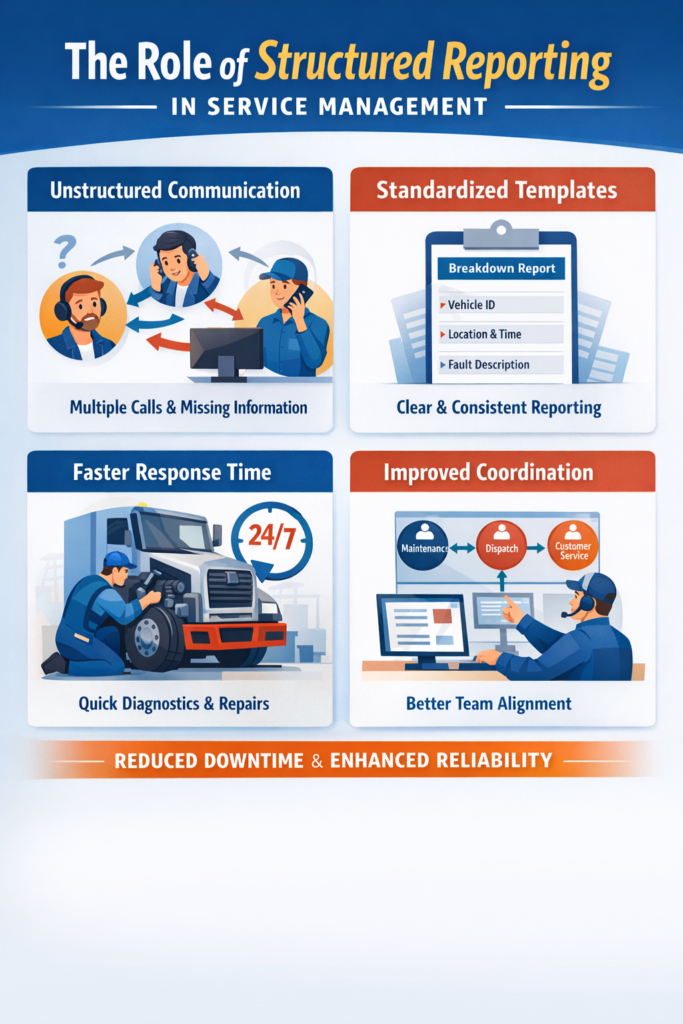
The Role of Structured Reporting in Service Management
The trucking industry has seen how unstructured issue reporting has led to problems like: multiple phone calls; missing data; and repair delays. The truck driver may explain a breakdown verbally while dispatch talks about routing and customer support informs partial information to clients. This disconnection creates downtime and damages credibility.
Service management is all about speed. If there is a difference in the reporting style for every breakdown, the maintenance teams will have to interpret first, reverify, and deactivate the collected information. This friction gets eliminated because of the enforcement of structured breakdown templates that detail the standard flow of information, regardless of the person’s reporting the incident or time when it takes place.
Turn your service management upside down with structured breakdown templates that specify what needs to be reported, when it is reported, and how it is processed up the chain. They not only allow conscious reporting but also ensure that every incident has the most needed tech data and operational details. In terms of fleet service management, this kind of structure brings speed in diagnostics, better coordination, and clear accountability through various teams, especially in high traffic vehicle situations.
Essential Features of the Reporting Templates
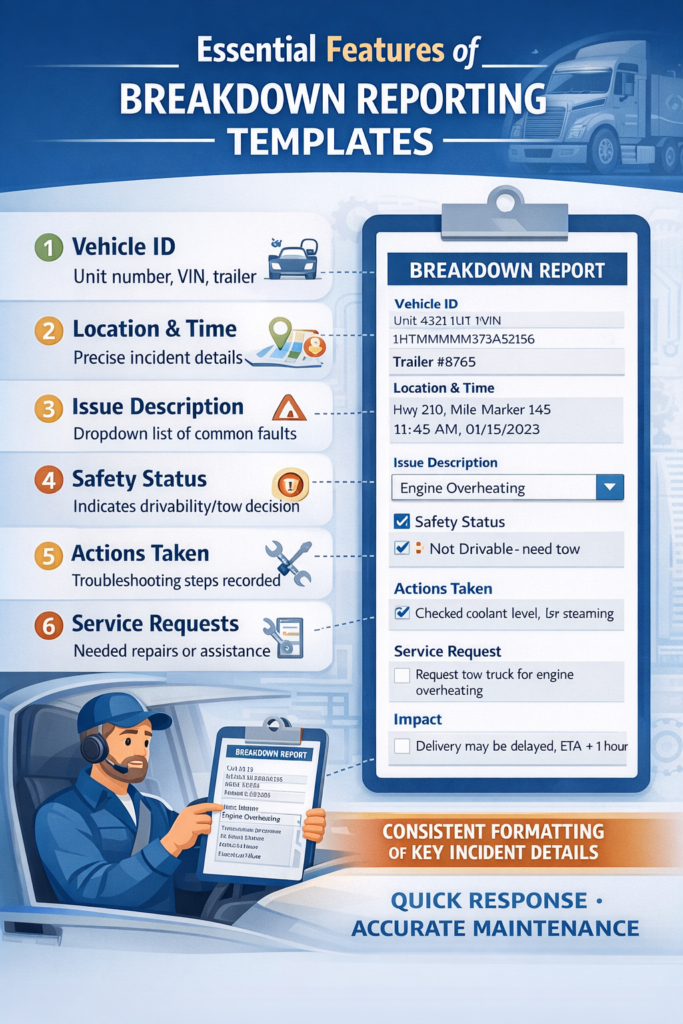
The most effective breakdown reporting templates in truck operations might possibly have:
- Vehicle identification (unit number, VIN, trailer)
- Location and time of incident
- Technical issue description
- Safety status and drivability
- Initial troubleshooting actions taken
- Required support or service requests
- Estimated impact on delivery or schedule
Other than listing fields, the actual worth is to see these components being structured. Neat note fields, dropdown fault selection, and mandatory safety indicators are great measures for eliminating ambiguity. When templates are created with real operational input, drivers get guided toward relevant details instead of their read of the situation.
These elements are the backbone of technical report templates suitable for both maintenance and customer communication teams. Consistent template design, like that of the consistent technical report form, will help in avoiding omissions in high-pressure situations where drivers are stressed, and time is constrained.
Breakdown Report Core Fields and Purpose
| Template Field | Purpose in Operations |
| Vehicle ID | Prevents unit mix-ups and delays |
| Location & Time | Enables faster roadside assistance |
| Fault Description | Guides initial diagnostics |
| Safety Status | Determines tow vs. drive decision |
| Service Request | Triggers maintenance workflow |
| Delivery Impact | Enables proactive client updates |
Service Recovery Communication Playbook
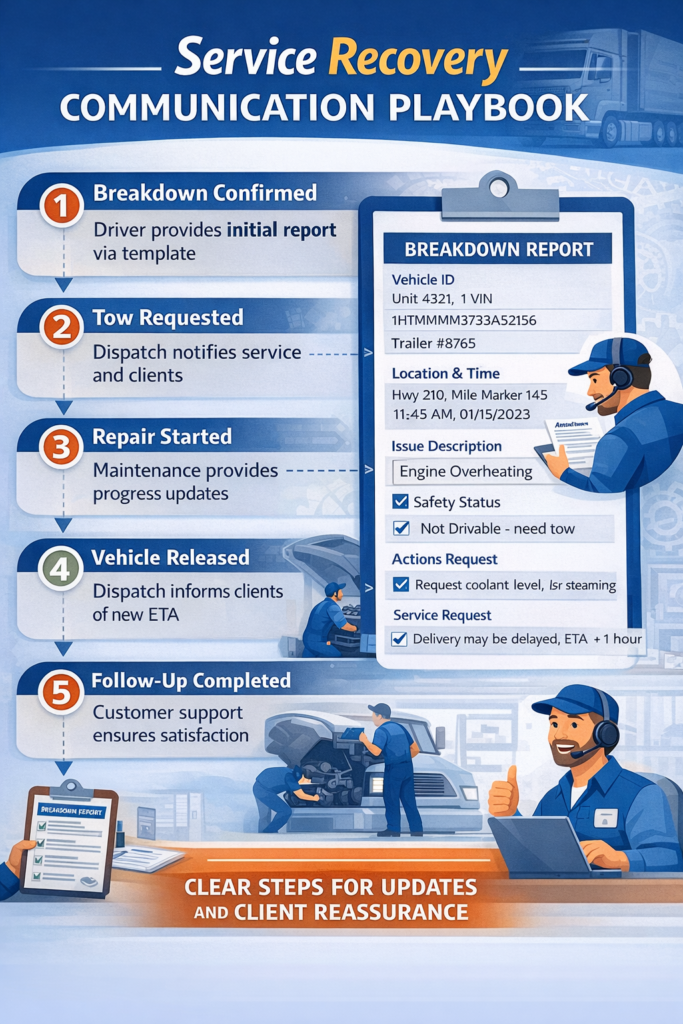
The breakdown incident is not just about repairing the truck — it is also about controlling customer expectations. A Service recovery communication playbook explains how the internal teams and clients are controlled, updated, and reassured throughout the incident’s lifetime.
In the trucking business, it is seen that customers often put up with delays more than they do not know what the problem is. A playbook that is structured ensures that the communication is intentional and not a random thought. It brings together the dispatch actions in line with the messages which are directed toward the customers and ensures that no contradictory updates that destroy trust occur.
A clear playbook is a great facilitator for the frontline staff too. Instead of creating messages in a hurry, the team uses certain methods of communication that agree with the company’s standard and the law.
Scope and Prospects
The main goal of the service recovery playbook is to standard service communication with the operating reality. The strengths of correct client information are especially convincing and help to prevent channeling the frustration to long-term relationships that are risked through vagueness or silence.
The playbook does not just cater to outside communication but also makes the inside even clearer. The dispatch, maintenance, and customer service departments will share the same incident timeline which will cut redundant work and remain clear of inner conflicts. This alignment moves the company quickly in times of breakdowns when the situation is severe.
Benefits include:
- Faster alignment between dispatch, maintenance, and customer service
- Consistent communication methods across incidents
- Reduced client complaints and improved customer feedback
- Stronger perception of professionalism during disruptions
Implementation Steps
To set up a service recovery communication playbook:
- Identify trigger points (breakdown confirmed, tow requested, repair started, vehicle released)
- Assign communication ownership at each step
- Prepare pre-approved message templates
- Establish standards for update frequency
- Document escalation paths for high-impact incidents
The implementation stage is not a line but a queue of real-life steps that should be taken not only on paper. Dry runs on historical breakdown cases will pinpoint gaps and any unrealistic timing assumptions identified. The playbook evolves with the situation into a viable tool of operation instead of a dead letter policy.
The results of these steps are that the service customer communication remains proactive and not reactive even when it is a tough breakdown issue.
Customer Support Work Breakdown Structure
The handling of breakdowns is more than templates — it is also having a view of structured support tasks. A customer support WBS work breakdown structure that organizes activities into manageable units that align with service delivery goals.
In trucking, a breakdown handling process often involves a multitude of departments and shifts. Without a WBS, some tasks may overlap, while others can be missed. A structured breakdown of the tasks will ensure fault continuity from the start of the incident up to the resolution, regardless of time or personnel changes.
Setting Up Support Tasks
In a truck driving operation framework, support tasks commonly consist of:
- Incident intake and verification
- Maintenance coordination
- Driver support and safety checks
- Client notification and updates
- Documentation and reporting
- Post-incident review
Each task serves its defined operational purpose. By grouping them logically, teams can prioritize actions rather than reacting randomly. Reporting tools and support templates become more effective when they are part of a clear operational structure rather than being used in isolation.
Support Tasks by Function
| Function | Primary Responsibility |
| Driver | Initial issue reporting |
| Dispatch | Routing and timeline control |
| Maintenance | Diagnostics and repair |
| Customer Service | Client communication |
| Management | Escalation and review |
Assigning Responsibilities and Deadlines
Each task in the WBS should have a defined owner and response time. For example:
- Driver submits issue reporting within 15 minutes
- Maintenance reviews repair reports within 30 minutes
- Customer service sends first client communication within 45 minutes
Every incident will therefore cause the templates to be effective through the deadlines they set. When there is no timing expectation, even the optimal reporting tool is rendered ineffective. The assignment of responsibility will also help in audits and also be clearly reflected in the post-incident analysis.
Incident Communication Templates
Incident communication templates are set in a way that explains the delivery of information during the times of service interruption. In trucking, these formats help keep the consistency in the communication channel applicable across several clients, routes, and time zones.
These templates protect the company in legal and reputational terms. The standardized phrases have a reducing effect on speculative or untrue statements which if made could result in liabilities that can not be settled under the ever-changing circumstances.
Communicating During Service Outages
During a service outage caused by a breakdown, communication must be factual, calm, and structured. The templates generally consist of:
- Confirmation of the incident
- Known impact on service delivery
- Actions being taken
- Expected next update time
The framework of this structure is to build a lodge of reassurance of clients that the situation has been taken into control. It also prevents over-communication which might cause to swamp the clients with unnecessary technical information.
Best Practices and Specifics
Some best practices that should be followed for the incident communication templates include:
- Avoid technical jargon when communicating with clients
- Separate internal technical details from external messages
- Keep messages concise and update regularly
- Align tone with brand and customer service standards
Internal vs. External Communication Focus
| Audience | Focus |
| Internal Teams | Technical accuracy, diagnostics |
| Clients | Impact, timing, reassurance |
The proper incident reporting joined to the clear communication will be the basis for the confidence of the client even when the business is disrupted for a period of time.
Customer Service Plan Report
A customer service plan report is one that documents the strategic handling of breakdowns and service incidents at a very high level. This paper constitutes the operational reality of the communication strategy that looks ahead.
For a trucking company, such a plan will let the management see the problems that repeat, the gaps in communication, and the performance trends across routes and clients.
Establishing a Service Strategy
The service strategy a trucking company needs to have should include:
- Frequency and types of breakdowns
- Communication channels used (phone, email, portal)
- Client expectations by service tier
- Feedback loops and improvement processes
This view of the business helps to ensure that the reporting templates and communication tools are not just existing in isolation but are actively supporting the business goals.
Using Templates for Consistency
Templates make sure that no matter who is the staff on duty customer service responses will remain the same. Standard service reports, support templates, and breakdown templates that are used can lower variability and thus protect the service quality across shifts and regions.
Consistency helps in training too. New staff learn the communication patterns that are already in place instead of making things up under stress.
Conclusion
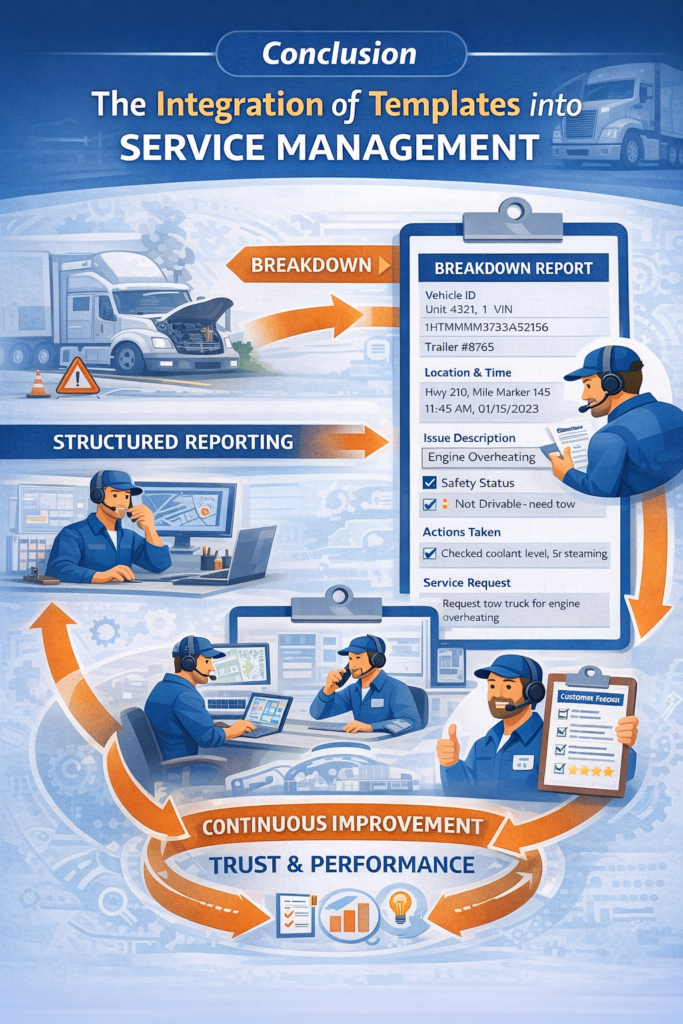
The Integration of Templates into Service Management
Breakdown reporting templates are not just separate documents — they are part of a bigger service management system. When they are plugged into dispatch workflows, maintenance processes, and customer communication plans, they become part of the operational resilience toolkits.
So in truck driving, where the delays are expensive and the visibility is key, structured templates help turn breakdowns which are unpredictable events into disciplined and manageable processes.
The Continuous Improvement of Templates
No template should ever feel like a final version. Regular closeouts of issue reporting, customer feedback, and service outcomes are going to contribute to the improvement of template design and communication strategy. The reporting tools and the service communication practices should evolve just as the size of the fleet, the routes, and customer expectations do.
Through the continuous improvement of the reporting templates for breakdowns and the service customer communication, the trucking industry becomes more reliable, fosters trust, and achieves better long-term performance.
Mini FAQ
How should a truck operator report a maintenance breakdown?
The safest way to report a maintenance breakdown is by utilizing a pre-designed format that is capable of recording the technical issues, vehicle condition, and the effect of operations all at one spot. This scheme tends to work better as it increases the speed of diagnostics, minimizes the need for follow-up calls, and most importantly, maintains the same facts for surety for maintenance crew, dispatch, and customer service instead of fragmented updates.
Why does business communication play a vital role during service disruptions?
In the trucking sector, the business communication tool during disruptions is critical in establishing customers’ view of the company’s reliability and control. Concise, concrete updates that contain facts will block the assumptions, cut back the escalation, and preserve the trust even when the service delivery is defective. The organized communication will also ensure that the messages remain consistent across departments and will be in accordance with the operational reality.
What is breakdown reporting in effect responding commands?
Breakdown reporting becomes effective reporting when it delivers accurate information at the right time to the right audience. Using standardized templates ensures completeness, clarity, and traceability, allowing teams to act quickly while management gains visibility for analysis and improvement.