Downtime as a Performance Reset Instead of Lost Productivity
Most drivers perceive unplanned downtime as lost productivity. Just as a performance-resting mechanism works for downtime instead of a loss. Taking a long drive for an extended period exhausts you physically, mentally, and emotionally through layers of fatigue. Without breaks to release those layers built up over time, burnout is the result.
This is where downtime comes into the picture. For instance, when drivers actively choose to change their mode from “output” to “recovery”, they experience an overall improvement in their driving performance. The reaction times balance out, decision-making becomes more composed, and the emotional control is stronger. An example would be the CDL drivers who are working under extreme time pressure, which can be very taxing on their minds and thus, it directly affects their safety.
The answer is structure. Randomly utilized downtime causes stress and rumination. Planed over and over again downtime deals with stress issues, leading to healing.
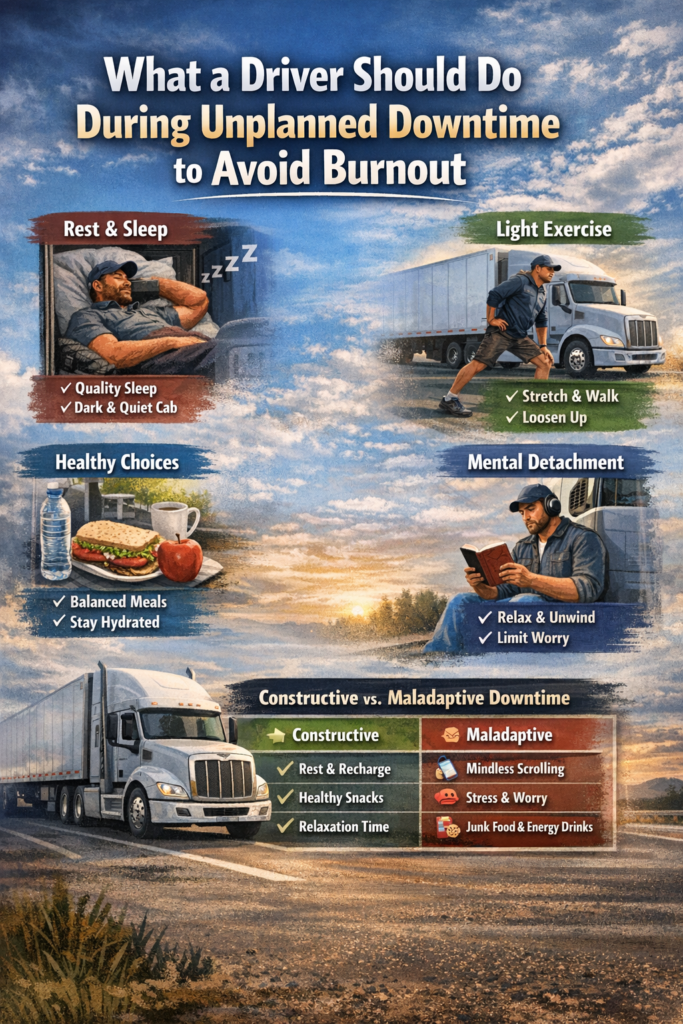
Constructive vs. Maladaptive Use of Unplanned Downtime
| Downtime Behavior | Short-Term Effect | Long-Term Impact |
| Scrolling endlessly on phone | Mental overstimulation | Increased fatigue, poor sleep quality |
| Worrying about lost miles | Elevated stress | Higher risk of driver burnout |
| Light stretching and walking | Immediate relief | Improved physical health |
| Short rest or nap | Energy recovery | Better alertness behind the wheel |
| Balanced meal and hydration | Stable energy | Reduced stress and irritability |
| Intentional mental disengagement | Emotional reset | Lower burnout risk |
Building Simple Downtime Routine for Truck Drivers
A proven way disallowing burnout is sticking to a downtime routine that repeats over time. This does not need to be elaborate or take a long time. It is a sign to the nervous system that it is safe to rest.
A practical, unstructured downtime routine can include:
- 5–10 minute physical activity (walking, stretching)
- Hydration first, caffeine only if needed
- One grounding activity (breathing, music, journaling)
- Rest with no guilt, even when the sleep is brief
This stable routine helps improve mental health by diminishing uncertainties. The brain stress is reduced when it knows what comes next. Over the course of time, drivers that make use of a stable routine, report little emotional spikes during delays and quicker recoveries afterward.
Physical Health Role in Burnout Prevention
Burnout is usually viewed as\ a mental problem, but it largely comes from the body. Health deterioration due to sitting for a long time manifests as back, hip, shoulder, and circulatory system issues. Putting physical issues second during downtime leads to speedier depletion.
The use of downtime not only for the mental aspect includes supporting the physical health, but no workouts are necessary. A few nimble actions are the key:
- Very light stretching to battle back stiffness from sitting too longWe hip stretching, back stretching, shoulder stretching, and self-rehabilitation.
- Feeling – refreshed, pain-free
- This might open new pathways for drivers. They learn to react in a different way to demanding situations.
Physical Symptoms of Burnout Vs Recovery Indicators
| Signal | Burnout Pattern | Recovery Pattern |
| Muscle Tension | Chronic stiffness | Looseness after movement |
| Sleep | Fragmented, shallow | Deeper, more restorative |
| Energy | Sudden crashes | Stable throughout shift |
| Mood | Irritability, impatience | Calm, focused |
| Focus | Mental fog | Clear decision-making |
Mental Detachment: Missing Skill in Trucking
Many truck drivers have a harder time not because of the workload that they have, but rather because they never want to take their minds off work. As a result, even during the unstructured downtime, they think about what dispatch has or will have on their mind, scenarios about delays, and transportation issues that can occur in the future.
Mental detachment is a skill to develop, and the best time to do it is during downtime.
To practice mental detachment, the following are useful:
- Setting a mental “off-duty” window
- Limiting repetitive problem-focused thinking
- Replacing rumination with neutral activities (music, reading, light entertainment)
In result, driver’s mental health stays intact, thus preventing stress to spill over into their rest periods. People who practice the skill of detachment have greater job satisfaction and they suffer from burnout symptoms less.
Stress Amplifiers vs. Stress Reducers During Downtime
| Stress Amplifier | Stress Reducer |
| Constant ETA checking | Accepting uncertainty |
| Replaying negative scenarios | Focusing on present actions |
| Excessive communication | Clear update, then pause |
| Skipping meals | Eating balanced meals |
| Forcing productivity | Prioritizing rest |
Long-Term Benefits of Healthy Downtime Habits
When unplanned downtime is properly used, its gains are not confined to just the break itself. Over the course of months and years, drivers will attain:
- Reduced burnout rate
- Better sleep quality
- More emotional control during high-pressure situation driving
- Less chances of injury and fatigue are built up
All these advantages directly mean to any truck driver a problem-free career. The fact that burnout is not an issue anymore, as it is neither the driver’s inability to drive nor the absence of missing driving lessons, contributes to that.
Downtime is NOT the enemy. Poor recovery is.
Combined Article What to do During Unplanned Downtime to Avoid Burnout as a Driver

Unplanned downtime is a frequent part of everyday life behind the wheel. Weather delays, breakdowns, missed appointments, or hours-of-service constraints can leave a truck driver parked unexpectedly, often frustrated and mentally drained. The unfortunate would downturn be the time when a truck driver suffers from burnout but, it can be avoided if managed right.
According to a market research report, truck drivers suffer from burnout when they face a series of bad situations in a row and continue to drive in the same unhealthy manner. The time spent on driving increases, the recovery time is not enough, stress is not managed, and the driver’s emotional and physical health is neglected. Unplanned downtime, when used correctly, can be the disruptor that that cycle needs, and thus it doesn’t need to worsen them.
Why Unplanned Downtime Triggers Driver Burnout
The experience of downtime is quite different from the experience of a rest. Planned breaks the mind prepares for and accepts. Unplanned downtime usually shows up with uncertainty. How long is it going to take? Would I miss a load? Would that affect my pay?
This uncertainty causes a spike in stress hormones, leads to poor sleep, and threats the brain to be in a permanent alert state. The situation over the long term leads to burn-outs among drivers, especially when downtime is spent in anxiety rather than recovery.
The solution is not to “kill time” but to avoid burnout by turning mandatory stops into structured recovery time.
TRUCKER TALK: How to PREVENT BURNOUT
Step one, change your mindset about downtime: not a time for failures, but time for recovery.
The initial and most important change has to be in the mentality. Un-planned downtime is not a mistake; it is a compulsory recovery.
The truck driver who sees the downtime solely as loss of productivity, is in a state of mindfulness with work even when he is on suspend. That is what stops the rest. Instead:
- Accept that your movement has stopped but recovery can begin.
- Detach from the pressure of dispatch mentally, when there is nothing to be done.
- Treat downtime as part of the job, not a disruption of it.
Just this change of perspective goes a long way in diminishing stress and emotional burnout.
Prioritize Proper Rest and Sleep Quality
Sleep is the cornerstone of burnout prevention. Many drivers overlook the importance of sufficient rest during the downtime. According to the CDC/NIOSH, long-haul truck drivers face significant fatigue-related health and safety risks due to irregular sleep patterns, limited recovery opportunities, and extended periods behind the wheel. These factors not only impair alertness but also contribute to mental and physical stress if not properly managed. Quality sleep and structured downtime are therefore essential, not optional, for maintaining driver health and performance during unplanned downtime (CDC/NIOSH). https://www.cdc.gov/niosh/motor-vehicle/long-haul-truck-drivers/index.html?utm_source=chatgpt.com
- Use the time with downtime for sleep even if it is not a conventional frame.
- Restore the cab as a dark space and reduce the noise as much as possible.
- If sleep will be possible only in a few hours’ time, then avoiding caffeine is preferable.
The picoseconds of good-quality sleep during a bending process can noticeably change a driver’s response time, mood, and resilience. Quality of sleep during transit can offset the accumulated fatigue which would otherwise linger on for days.
Rest Breaks for the Physical Reset
Burnout it not only mental – it is physical, too. Long hours of sitting, vibration, and tension accumulate fast.
Use downtime to take regular breaks from sitting in the driver’s seat by:
- Walking for 5–10 minutes
- Doing light stretching for hips, back, shoulders, and neck.
- Restoring circulation after long periods of immobility
These small actions help with your physical health and they decrease the chronic pain, which is sent to your brain.
Make Healthy Choices Instead of Easy Choices
By the end of the day, what you eat, think, and how you act adds to the problem of fatigue and mood. Unplanned downtime very often results in bad choices such as fast food, energy drinks, and not doing activities that are supposed.
Instead, use the opportunities to make healthy choices:
- Use healthy meals as a priority even if they are simple to prepare.
- Drink water instead of stimulant drinks.
- Avoid eating too much out of boredom or internally when you are frustrated.
Good nutrition leads to stable energy levels and enhances the emotional control that the driver will need to fight against burnout.
Have Stress with Straightforward Coping Mechanisms
Stress when present in your downtime mostly comes from your inability to control the situation. You cannot do anything to solve the matter however, you could control how you respond.
Some of the most useful tools include:
- Taking controlled breaths to calm down the nervous system activation.
- Documenting or writing notes to redirect mental pressure.
- Listening to relaxing music instead of hard news or work calls.
Learning to deal with stress in a forced stop enables drivers to keep the balance not only during breaks but during the days when driving is demanding as well.
Protect mental health through intentional disconnection.
Sometimes drivers stay mentally “on duty” even when they park their trucks. This chain of events prevents recovery.
To protect your mental health:
- Limit unnecessary communication once the situation is reported
- Avoid replaying “what if” scenarios
- Give yourself permission to mentally clock out
Mental rest is as important as physical rest for avoiding truck driver burnout.
Avoid the Pitfall of Driving Physical Activities
Some drivers, after which, try to atone for the downtime by overworking themself. This in turn creates a stress-filled middle. Stop, stress, overdrive, and finally, exhaustion from that cycle.
A driver’s thoughts of “I must make up for the lost time” is the secret behind condoning burnout. Balancing is what brings sustained success, not compensating for something.
Unplanned downtime should be used to decrease the burden, not to increase it later.
Transforming Impossible Time Off into A Bouquet of Burnout Prevention
When made intentionally, the downtime will act as a cushion against burnout instead of making it worse.
If used properly, it can enable drivers to:
- Reset mentally and physically
- Restore energy and focus
- Improve long-term performance behind the wheel
For any CDL driver, the key issue in burnout prevention is not about completely avoiding downtime. It is simply about handling it the right way.
Additional Notes on Burnout Prevention During Downtime
- Unplanned stops are often the only moments when rest breaks happen naturally, and using them intentionally helps the body and mind reset without forcing recovery later under pressure.
- Choosing eating balanced meals during downtime stabilizes blood sugar levels and prevents emotional swings that commonly follow long hours of uncertainty and waiting.
- Drivers who consciously prioritize rest during forced stops recover faster than those who treat downtime as wasted time and stay mentally overworked.
- Without adequate rest, even short periods of delay turn into cumulative fatigue that carries over into the next driving shift.
- Learning how to manage stress during downtime determines whether the pause restores energy or silently accelerates burnout.
- Extended continuous driving without recovery windows is one of the fastest paths to long-term physical and emotional exhaustion.
- For a cdl driver, downtime is not an interruption of work but a built-in opportunity to protect long-term performance and safety.
- Simple coping mechanisms, such as breathing control or mental disengagement, allow downtime to function as recovery instead of frustration.
Final Words

Burnout does not arise from a single instance of delay or a day. It grows when recovery is neglected and stress is permitted to be unending.
Unplanned downtime will forever be part of the trucking industry. The surviving drivers are the ones who reboot themselves into recovery – through rest, movement, nutrition, and mental detachment.
For a professional truck driver, mastering burnout avoidance during downtime is no longer a choice. It’s a fundamental and core-existence skill for a long-term and sustainable career.