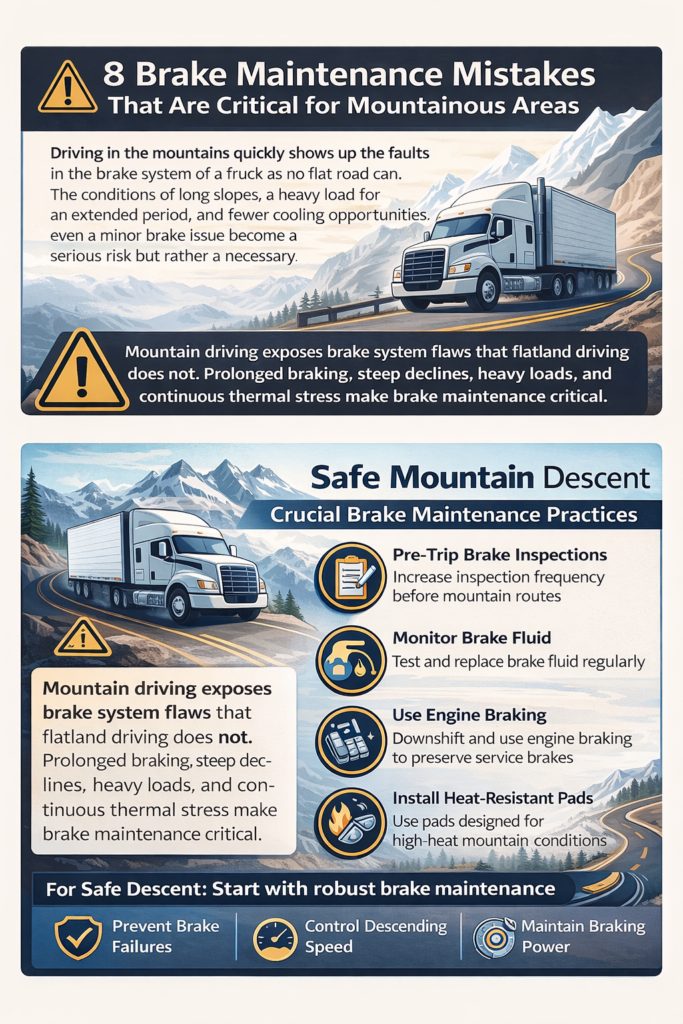
Driving in the mountains quickly shows up the faults in the brake system of a truck as no flat road can. The conditions of long slopes, a heavy load for an extended period, and fewer cooling opportunities, even a minor brake issue become a serious risk. Thus, brake maintenance in the mountains is not a routine task but rather a necessary action connected to life and death issues on steep grades.
The article provides a summary of the eight brake maintenance mistakes that are very dangerous while driving in the mountains and describes them further by telling how they develop and why they lead to brake problems on steep descents.These brake mistakes are rarely obvious on flat roads, but mountain driving exposes them immediately by removing any margin for error.
1. Ignoring Brake Inspection Frequency Before Driving to the Mountain
A lot of drivers depend on the standard inspection intervals that are set for flat terrains. This plan works only for a short time in the mountains. Continuous braking on downhill sections results in a considerable amount of wear and increases the power of the small defects.
On long downhill rides, the old brake pads and the undersized components have overheating problems due to the fact that friction is not enough, and this in turn increases stopping distances. Issues that could be easily handled in traditional highways can turn into risks of brake failure in just minutes on roads around mountains.
The main inspection faults have to do with:
- the unevenness of the brake pads
- the presence of rotor heat spotting or micro-cracks
- the resistance on the caliper slide
- glazing that occurs too early because of the excessive heat
In close to mountainous driving conditions, the increase of brake inspection frequency is a must before one drives on steep terrains; it is not a choice but rather a pre-emptive measure.
2. Overlooking Brake Fluid Condition
Brake fluid is a heat-transfer medium and not just a hydraulic requirement. Old or contaminated brake fluid is a moisture absorber and as a result of this its boiling point is more reduced.
For example, if we are going downhill with too much heat, the brake fluid can vaporize shortly. This introduces compressible gas in the brake system, and as a result, this leads to a delayed response or the total lack of braking.
Mountain conditions contribute directly to degraded brake fluid causing:
- a loss of brake power due to the brake fade
- a soft feel at the pedal
- an unpredictable braking response
Regular fluid testing and replacement should be a part of the brake maintenance for mountain routes.
3. Relying on Service Brakes Instead of Engine Braking
An error in the use of the engine braking turns the art of driving into a maintenance problem. Drivers who take long descents without shifting into a lower gear overload the service brakes continuously.Engine braking is one of the key elements that allows a controlled and safe descent without overwhelming the service brakes.
This is done in such a way to avoid engine braking which creates excessive heat throughout the whole braking system:
- the brake pads end up overheating and glancing
- the rotors bend from stress caused by high temperature
- the calipers bear an uneven load
The engine braking, on the other hand, is the one that distributes energy absorption in the drivetrain which leads to the preservation of the braking capacity enabling the driver to brake in a safe way without thermally overload.
4. Installing Incorrect Brake Pads for Mountain Conditions
Not every brake pad is made for long-lasting downhill heat. Urban and highway pads easily get rid of sliding friction when they are exposed to longer periods of high heat.
The incorrect brake pads in mountainous driving can result in:
- fast wear
- less friction at higher temperatures
- and brake fading through the process of rapid development
The brake maintenance on mountain roads should be determined not only by the stopping power at normal conditions but also by the thermal resistance.
5. Ignoring Early Signs of Brake Fade
Brake fade is a continuous failure and it is not a sudden event. It starts with heat saturation that reduces the friction between the pads and rotors.
Drivers usually ignore the initial signs such as:
- the pedal taking longer to travel
- quantities of stopping confidence
- a burning smell after descend
Taking these symptoms as “normal for mountains” is wrong. They are signals of brake fade and as such, they must be taken seriously, and necessary actions should be made.
6. Neglecting Rotor and Caliper Health
Most of the braking heat is absorbed and dissipated by rotors and calipers. Due to the ambient temperatures in the mountains, the metal is fatigued through the repeating cycle of heating and cooling.
Issues related to neglecting the rotors and calipers are:
- a variation in rotor thickness
- slide binding in the caliper
- and an uneven distribution of pressure
An overheated or trapped caliper increases the brake issue in the downhill braking because of the brake system imbalance.
7. Postponing Brake Repair After Minor Issues
Small brake problems can become big issues fast in a hilly area. Not following through with brake repair if the noise, vibration, or pulling are present caused issues in turn to the compound failure.
Small issues can develop into:
- rotors being scored by the brakes
- the calipers being seized
- the pad wearing out irregularly
In mountain driving, the act of deferral deletes the safety margins and increases the chances of brake failures on the downhill areas.
8. Failing to Adapt Maintenance to Mountain Roads
The last mistake that happens is trying to apply flat-terrain maintenance logic to mountain roads. Mountain driving is characterized by prolonged braking, less cooling, and continuous thermal cycling.
As a result, the strategies for brake maintenance must change:
- by shortening the time between services
- upgrading the component specifications
- and deepening the inspection
If they do not change, the brake systems will automatically wear out faster and break down.
Brake Maintenance Mistakes and Their Mountain Consequences
| Brake Maintenance Mistake | What Happens in Mountains | Resulting Risk |
| Infrequent inspections | Hidden wear escalates quickly | Brake failure on descent |
| Old brake fluid | Fluid boils under heat | Loss of braking response |
| No engine braking | Excessive brake heat | Accelerated brake fade |
| Wrong brake pads | Low thermal tolerance | Reduced stopping power |
| Ignored fade symptoms | Progressive friction loss | Uncontrolled descent |
Why Mountainous Driving Exposes Brake Problems Faster
Mountain road design consists of steep declines, load pressure, and the application of brakes over and over again. The surplus of heat resulting from that wears out the brake parts faster, emphasizes the latent issues and thus the recovery time of the system is shortened.
On bad maintenance, a brake system that is fine during high traffic can be in great trouble after a single mountain run.
Brake System Components Under Mountain Stress
| Brake System Component | Primary Stress Factor | Maintenance Focus |
| Brake pads | Excessive heat | Thermal rating & wear checks |
| Rotor | Heat cycling | Thickness and crack inspection |
| Caliper | Uneven loading | Slide lubrication & movement |
| Brake fluid | High temperature | Moisture and boiling point |
| Entire brake system | Sustained braking | Integrated inspection approach |
Key Brake Maintenance Practices for Safe Mountain Descents
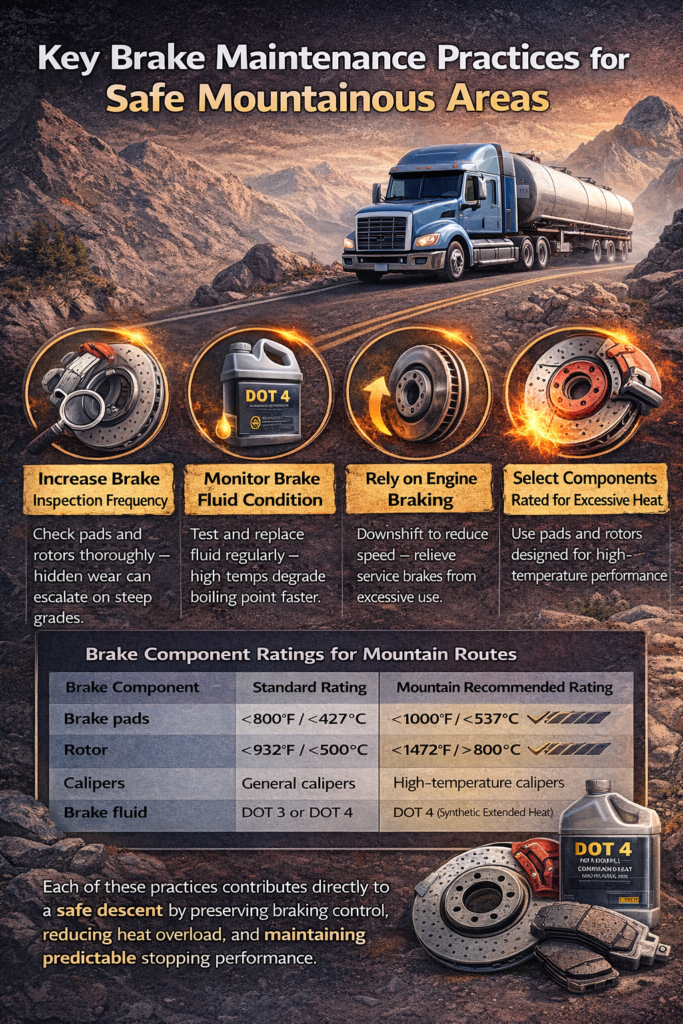
To reduce brake issues and ensure control:
- increase brake inspection frequency before mountain routes
- monitor brake fluid condition
- rely on engine braking and lower gear selection
- select components rated for excessive heat
- address early brake problems immediately
The brake maintenance in mountains is fundamentally conducting enhancement of the heat transfer of the system and making it predictable.
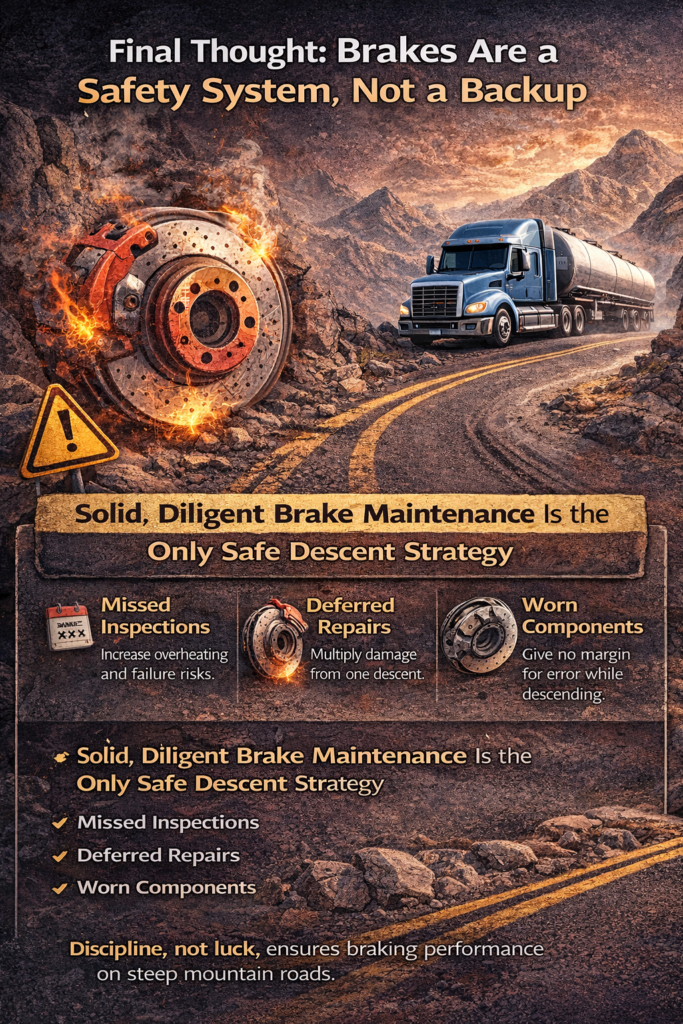
Final Thought: Brakes Are a Safety System, Not a Backup
Downhill slopes where brakes are not the redundancy but the very main system of safety decide a descent that is controlled or turns into an emergency. Long downhill grades inflict constant thermal and mechanical damage on the entire brake assembly, creating a zero-error margin that might not be seen on flat fields. The braking failures that mainly occur the most while going down mountain roads are not unexpected nor sudden; instead, they are the direct effect of maintenance choices — or brake errors — which have been made much earlier than the truck’s arrival at high elevation.
Driving in the mountains accentuates brake maintenance issues at an even greater level. Worn parts, fluid loss, or missed checks quickly multiply under persistent braking force. The present state of the system, which is less effective, leads to the creation of more heat, fading response, and, in the end, system control loss. Here, even an adequately skilled driver is not able to balance out a malfunctioned brake system. Only motion cannot defeat the mechanical disuse.
A foundation of solid braking is founded through disciplined preparation. The right inspections before the mountain routes, the right components for the high-heat environment, and the right timing of repairs all add up to it. Consequently, the braking system is going to be reliable even during prolonged service descents. The brake performance being proper, drivers should focus on speed control, lane positioning, and traffic awareness more than on dealing with the brake system failure.
Those drivers who regard brake maintenance as an essential operational obligation show higher professional standards. They are forward thinkers, they respect the equipment’s limitations, and they realize that safety is tied up with maintenance. Therefore, this way of thinking gives a direct way to a safe descending by means of not only chance or reaction but also preparedness and the system’s reliability.
All in all, riding on a mountain is a test of both discipline and neglect. The mountains receive trucks that were sent in well kept and return them under control. The implied cost is for those who haven’t had the lesson yet, that is, they have not yet realized that they are not a backup plan but rather the very means of survival on steep grades.